By Dalton Day
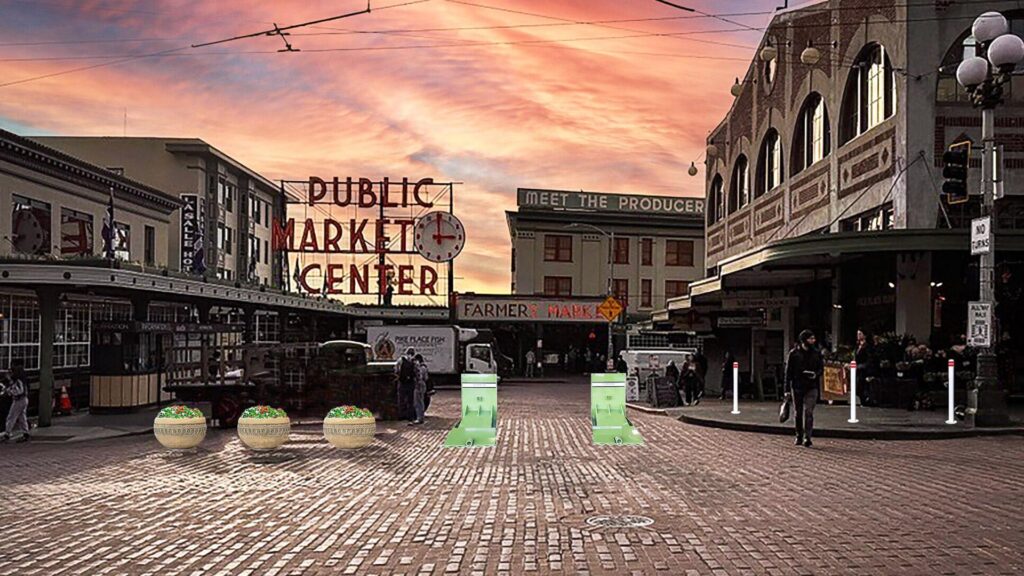
Seattle officials have released an early rendering showing what Pike Place Market could look like as new barriers are installed to limit vehicle traffic ahead of the FIFA Men’s World Cup.
For the World Cup and the remainder of summer, the Seattle Department of Transportation plans to use a mix of temporary barriers, including concrete planters, mobile barricades and fixed posts, along with continued use of the market’s historic truck for traffic control.
The temporary changes are intended to help the city gather data and plan for longer-term upgrades, which could include more robust, adjustable barricades that would take longer to build and could better support business loading needs.
The concept design, presented to the Pike Place Market Historical Commission, offers a preview of how those barriers could be placed at key entrances, including First Avenue South and Pike Street. Officials emphasized the design is preliminary and could change.
SDOT said it plans to install the barriers as soon as April as part of a broader strategy to limit passenger vehicle access in the market, though an exact installation date has not been scheduled.
“This timeline will allow SDOT and Pike Place Market staff to monitor how these temporary measures function ahead of the anticipated influx of visitors during the World Cup,” an SDOT spokesperson told KING 5.
The effort builds on a 2025 pilot program that used movable barriers to restrict traffic. City officials say the goal is to keep the market “a safe, people-friendly place” as Seattle prepares to welcome hundreds of thousands of visitors for the World Cup this summer.
SDOT’s Radcliffe Dacanay said the city is leaning toward mitigating risk rather than accepting it, with a focus on preventing vehicles from entering the market and potentially harming pedestrians.
Managed access at Pike Street and First Avenue would continue daily from 10 a.m. to 4 p.m., with hours adjusted for special events. Officials said full street closures are still under discussion with police and fire departments but would likely be limited to World Cup matches and major holidays such as Memorial Day weekend.
SDOT’s engineering and design manager Matt Beaulieu said the current designs are focused specifically on World Cup readiness, with longer-term conversations about a more permanent solution expected after July.
“We want shared streets, not closed streets,” Beaulieu said, noting that the department prefers planters that look historically appropriate over more industrial-style bollards. However, he acknowledged time constraints ahead of the tournament.
Officials said the planters would be removable using equipment such as forklifts or liftgate trucks, allowing emergency access when needed. SDOT is also working with the Urban Freight Lab and vendors to better understand delivery schedules and freight needs.