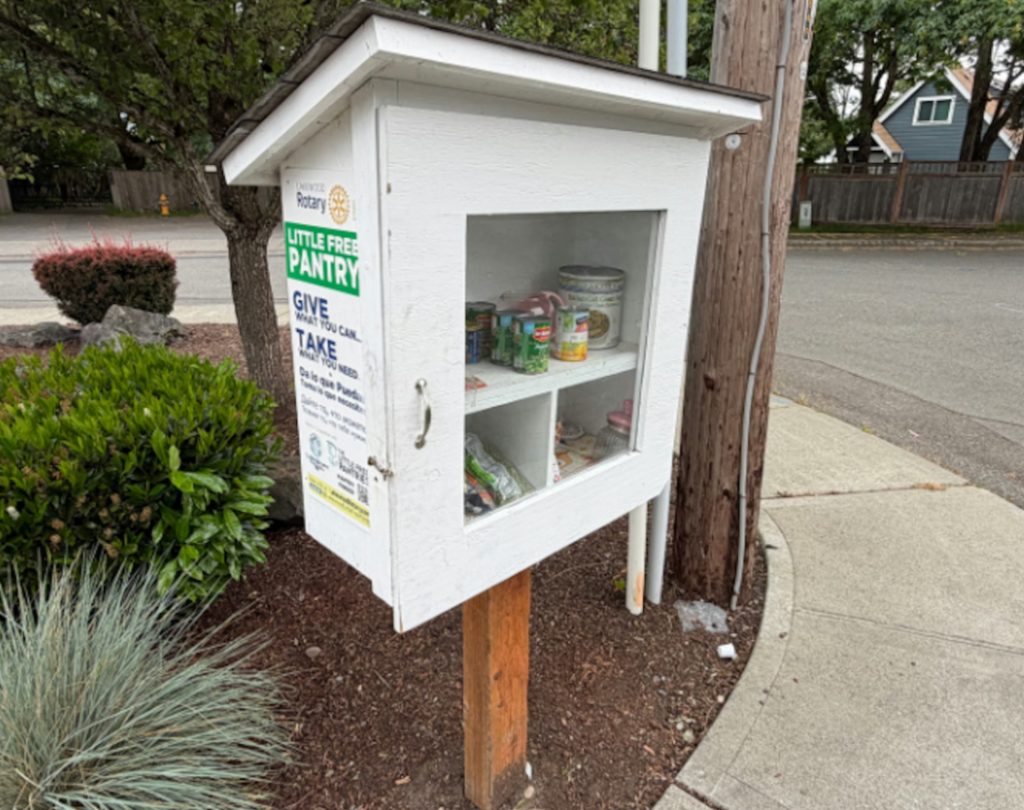
Little Free Pantries, aka micropantries, began popping up around Seattle during Covid pandemic shutdowns, and many have continued to operate. So many, that there’s now a map for that —PantryMap.org — run by researchers at the University of Washington.
“These are very small, literally little boxes, some of them are refrigerated,” Giacomo Dalla Chiara, a senior research scientist at UW, told Seattle Now. “They are completely unattended, mostly. Some are households that decided to a weekend project … and they kind of leave them be. Others are more well-managed and run by organizations that maintain them, clean them, restock them. So, there is a huge variety of forms.”
Little Free Pantries are not a new phenomenon. There are many in Seattle, throughout Western Washington, and across the United States. And there have been online maps to help people find them, such as this one. But the map put together by UW researchers goes a little further. It’s an attempt to better understand the micropantries, while doubling as a way for people to communicate about them — note what has been dropped off, what is needed, etc.
PantryMap.org lists micropantries in Seattle, but also a handful outside the city in neighboring communities, such as Kirkland, Everett, or the Port Madison Indian Reservation in Kitsap County. Each location on the map allows users to leave messages and even add a wish list for donation items.
Researchers have also equipped a handful of pantries with sensors. One sensor counts the number of times a door opens and closes, to give an idea of visits to the location. Another sensor measures the weight of food at the pantry.
Dalla Chiara said some data collected so far indicates:
- There are 20 visits per day, on average, at each pantry.
- An average of 30 pounds of food is being donated to each pantry each day.
- An estimated 4 million pounds of food is donated each year throughout the micropantry network in Seattle.
It’s not exactly known who is using the micropantries. Dalla Chiara said they have done surveys and found that “70% of the respondents are female with kids. And we were quite amazed by that.” He adds that micropantries are likely acting as complimentary services to food banks, which have seen a surge in demand in recent months.
“We’re trying to measure and quantify goodwill,” Dalla Chiara said in a statement. “Behind each little free pantry there is a whole system of behaviors — people trying to help one another. If we can understand that system better, we can support it better.”